
The US, EU and Southeast Asian markets are fast-moving. If you’ve had firsthand experience in these territories, then the Japanese customer journey can feel painfully slow in comparison.
As a foreign brand in Japan, you may interpret this stark contrast as weak intent among your target audience, or even poor performance of your campaigns. But you’re likely misunderstanding the market.
In This Article
The reality is that Japanese consumers simply make decisions very differently from elsewhere in the world. The typical Japanese conversion cycle is slower because it’s more methodical and much more research-heavy.
Once you’ve earned the trust of Japanese buyers, however, you can expect a loyal, long-term customer. Resist the urge to speed up the process unnaturally, and instead understand the why, and how to operate within that framework.
What Drives Japan’s Long Decision Cycles?
Japan is notorious for its slow-but-steady path to conversion, and the factors that shape this phenomenon are cultural in nature.
Trust-Based Mentality
In the West, even if you’ve never heard of a brand, your first question is “Do I want this?” If the interest is moderate, consumers are more keen to take a flier if the price point is just right.
In Japan however, the first question is “Can I trust this?” Brands have to pass a rigorous credibility threshold. Even if the intent and desire is high, there needs to be a significant amount of built-up trust before customers make the purchase.
Risk Aversion
Both B2B and B2C customers tend to be extremely risk-averse in Japan. They will go to great lengths to avoid a bad deal. In doing so, they employ key research pillars:
- Product comparisons
- Verifiable customer reviews and testimonials
- Online forums to ask questions and gain important feedback
- Cross-channel verification
Unlike most of their Western counterparts, due diligence is a high priority among the Japanese.
Brand Consistency
The slightest change in tone, even if you’re trying to match the vibe of specific platforms, can come off as a red flag. The same goes for pricing, and especially for product details. Japan rewards brands with more attention if they’re predictable and uniform in their messaging.
It’s a major trust signal that communicates reliability, accelerating the path to commitment.
How to Shorten the Japanese Customer Journey Without Forcing It
Some foreign brands have issues with patience, and thus attempt to compress the decision cycle rather than support it. As stated before, Japanese consumers aren’t slow because they lack interest. They’re simply eliminating uncertainty.
With this in mind, your objective should veer away from focusing on speed to removing friction. All you need to do is place yourself more in the perspective of the consumer.
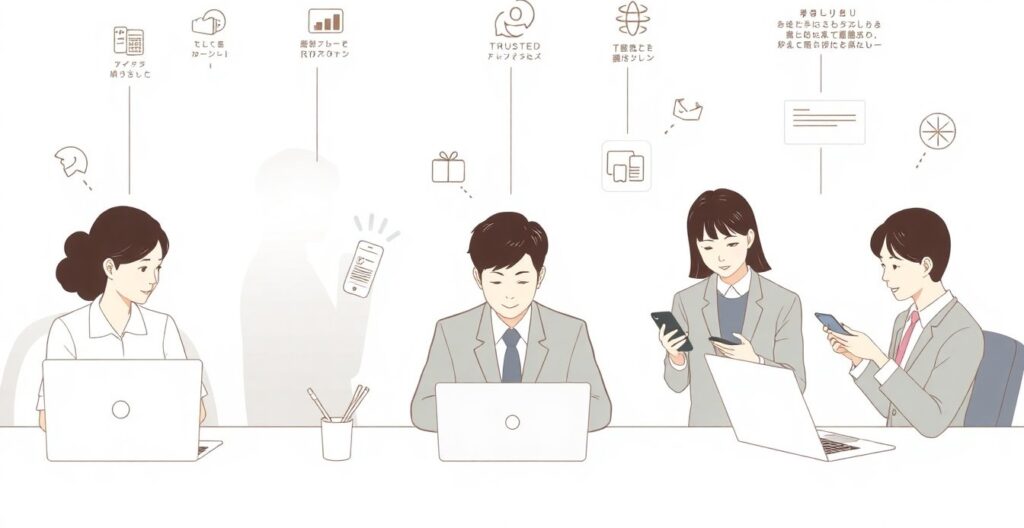
In practice, this translates to anticipating any questions or concerns a customer may have at various stages of research. Address them before they’re even raised. You’ll quickly realize that this demands a shift in messaging from urgency to reassurance.
By providing clear explanations, visible proof and timely communication, customers won’t need to stop too long at each stage. Consequently, although they are still able to move at their own pace, the result, ironically, is faster conversions.
Visualizing the Conversion Flow
We’ve briefly explained how to gently speed up the process, so let’s look at the best ways to apply these ideas for B2B and B2C.
Accelerating Conversions for B2C
For consumer brands, this will look more like a gradual soft-sell approach. A user’s initial encounter with a product might be through an ad or online market listing. Typically, they would visit the brand site to learn more.
At this point, instead of employing countdown timers or issuing discounts, a savvy brand would offer educational on the product’s value to everyday use. From there, follow-up communications via email or platforms like LINE should be used to reinforce that value via examples or reviews, free of pressure. At the point of conversion, the user’s decision to buy feels safe and autonomous.
How This Looks for B2B
In B2B environments, the same principle applies, only with more stakeholders involved. When you receive an initial inquiry, it’s rarely a buying signal. Usually, it’ll be a request for information to be shared internally.

Understanding this, take on the mindset of helping prospects move through their internal processes smoothly. Respond promptly with clear communication and detailed explanations. Every interaction reduces risk for the key decision-maker(s). This in turn increases likelihood of conversion while reducing the time it takes to get there.
Key Takeaway
Bottom line: Japan does not reward force, but it will absolutely reward foresight. You must take the time to empathize with the client/consumer. Invest in answering questions early. Maintain consistency across channels. Communicate with calm confidence and, above all, don’t rush.
At ICJ, we can guide you on campaign strategy with a deep understanding on Japanese market psychology. We’ve witnessed trends and changes in the Japanese customer journey over the years, and can apply the knowledge we’ve gained to your benefit.
